The Job and What's Involved
Graphic designers work to bring many kinds of communication alive. They produce designs that get their clients' messages across with high visual impact. The role demands a keen business sense as well as creative flair.
Graphic design input is required for a huge variety of products and activities, including:
- Websites
- Packaging
- Books and magazines
- Corporate identity - to give organisations a visual 'brand'
- Advertising
- Exhibitions and displays
- Computer games
Tasks are likely to include:
- Finding out about the project requirements (taking a 'brief').
- Estimating the time the project will require, and providing a cost quotation.
- Coming up with design concepts that fit the client's needs.
- Presenting options for design treatments.
- Creating final designs, working to a deadline and budget.
- Amending designs according to the clients' final comments.
- Proofreading and preparing designs to be sent to print.
Apart from rough sketches, most graphic design work is now done on computer. Graphic designers use specialised industry-standard graphics or multimedia software packages.
Designers may use different media - e.g. photography and illustration - to get the results they want.
Graphic designers may deal directly with their clients. Those working in an agency may take briefs from an account manager who has responsibility for client contact.
Designers also have to work closely with other colleagues involved in projects, such as copywriters, photographers and sales staff. In order to win work, they may take part in formal presentations to 'pitch' their ideas to potential clients.
Graphic designers usually work 37 hours a week, Monday to Friday. Extra hours are common, especially to meet critical project deadlines. Part-time work may be possible.
Many designers work on a freelance basis after gaining some years' experience.
The work is usually done in an open-plan design studio. It involves sitting and working at a computer for long periods. Self-employed designers may work from home or share studio space.
There may be some travel to meet clients.
Salaries for junior designers may start at around £11,000 a year.
Getting Started with this Career Choice
Around 185,000 people work across the design sector as a whole. There are nearly 40,000 businesses working in graphic design, ranging from major agencies to sole freelancers.
There are two main types of employer.
- Agencies carry out graphic design work for a range of clients. They may specialise in advertising, corporate communications or general graphic design.
- Many large organisations have in-house design teams. These include publishers, banks, retailers, government departments, local authorities, universities and packaging companies.
Employers are based all over the UK. Almost half of design agencies are in London and the South East.
The design sector is growing. However, because there are many higher education courses in graphic design, competition for vacancies can still be keen. Gaining early experience and building a portfolio of work is an advantage. Some graphic designers create websites to show off their work.
Vacancies are advertised in trade press, such as Design Week, or national press, such as The Guardian (Mondays). Some graphic design vacancies are filled through specialist recruitment agencies.
Education and Training
While there are no set entry requirements, most graphic designers have a degree or diploma. This may be in graphic design, illustration, fine art or a related subject. There are many courses at universities and arts colleges across the UK.
With enthusiasm and a strong portfolio of work, it may be possible to enter without a degree or diploma. However, qualifications make career progression easier.
Many students take a one-year Foundation Diploma in Art and Design before applying for a degree or diploma course. This enables students to try a variety of art and design subjects, and allows them to build up a portfolio of work. Entry requirements are usually five GCSE's/S grades (A-C/1-3), and sometimes A levels/H grades, or equivalent qualifications.
For a degree course, two A-levels/H grades are usually needed, including an art-related subject, as well as five GCSE's/S grades (A-C/1-3), or equivalent qualifications.
For BTEC national diplomas or certificates, entry requirements are four GCSE's/S grades (A-C/1-3). For a higher national certificate/higher national diploma (HNC/HND) course, entry requirements are one A level/two H grades in art and design subjects, or a BTEC national diploma/certificate in a relevant subject, or the equivalent.
Many institutions now offer Foundation degrees in art and design subjects. These usually involve two years of part-time study. Successful candidates then have the option of transferring to the latter stages of an honours degree course. Entry requirements vary between institutions.
With a first degree in a related subject, it is possible to apply for a postgraduate degree or diploma in specialised areas of graphic design.
A range of NVQ's/SVQ's in design subjects is also available.
A Few More Exams You Might Need
Employers generally expect new entrants to have learned the essential skills while completing their qualifications.
Employers may support further study, e.g. for a postgraduate degree or diploma. They may also provide in-house or external training in specific aspects of the job, such as presentation skills.
Graphic designers are expected to keep up to date with the latest trends in the industry. They may attend courses and demonstrations of new design software.
Featured Job Guide - Oil Drilling Roustabout
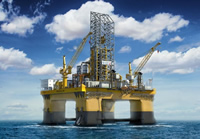
Oil Drilling Roustabouts and Roughnecks work as part of a small team on offshore oil or gas drilling rigs or production platforms. Roustabouts do unskilled manual labouring jobs on rigs and platforms, and Roughneck is a promotion from roustabout.
Roustabouts do basic tasks to help keep the rig and platform working efficiently and Roughnecks do practical tasks involved in the drilling operation, under the supervision of the driller.
________________________________________________________________________________
Skills and Personal Qualities Needed
A graphic designer must have:
- Creative flair.
- A strong visual sense.
- Originality.
- Strong computer skills.
- Confidence, to present and explain ideas to clients and colleagues.
- The ability to grasp client needs and consider practical solutions.
- The ability to pay attention to detail.
- The ability to balance work on several projects at a time.
- Good teamworking skills.
- Flexibility.
- An awareness of the competitive business environment in which they work.
- A matter-of-fact approach when ideas or designs are rejected.
Your Long Term Prospects
Junior designers can progress to a senior position. With further experience they may take on team management responsibilities, eventually becoming studio manager or creative director in an agency.
Those working for smaller companies may find limited opportunities for advancement. Many designers change employers to progress their career.
Graphic designers can specialise in a particular field, such as packaging or magazine design. With further training, they may move on to related fields such as animation or television and video graphics.
There may be opportunities for experienced designers to work abroad, e.g. in Europe and the USA.
Get Further Information
Chartered Society of Designers,
1 Cedar Court, Royal Oak Yard,
Bermondsey Street, London SE1 3GA
Tel: 020 7357 8088
Website: www.csd.org.uk
Design Business Association,
35-39 Old Street, London EC1V 9HX
Tel: 020 7251 9229
Website: www.dba.org.uk
Design Council,
34 Bow Street,
London WC2E 7DL
Tel: 020 7420 5200
Website: www.designcouncil.org.uk
Other Related Jobs
- Art Editor
- Exhibition Designer
- Fine Artist
- Illustrator
- Interactive Media Designer
- Product Designer
- Web Designer/Developer